domingo, 29 de abril de 2018

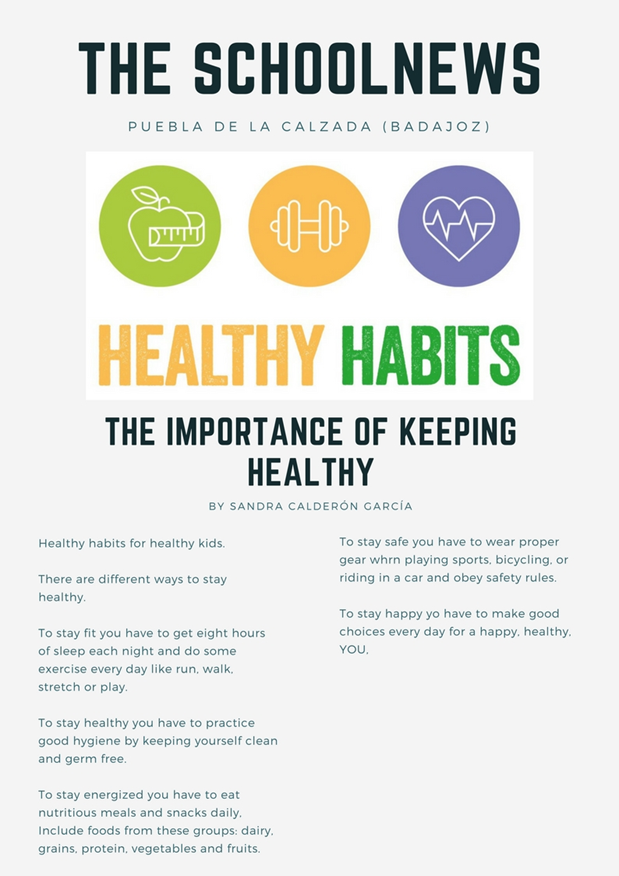
The importance of growing up healthy.

Title: Keeping healthy

Level: 3rd grade (Primary education)

Subject: Natural Science


This unit is related with the importance of growing up healthy and the objectives are:


Keeping healthy:

  • To introduce the main theme of the unit.
  • To actívate previous knowledge about keeping healthy.
  • To find out the role of pediatricians in health care.

Healthy habits:

  • To learn about benefits of physical exercise and good posture.
  • To identify ways of preventing health problems.
  • To discuss personal hygiene.

Food hygiene:

  • To distinguish between natural and processed foods.
  • To indentify the stages food goes before we consume it.
  • To find out diferent ways of preserving foods.

Leisure time and rest:

  • To learn about the importance of getting enough rest an sleep.
  • To find out about leisure activities.


I want that students be able to achieve these objectives through the following activities:


  • Tracks throught the unit :

https://www.sesamestreet.org/toolkits/healthyhabits


  • Healthy habits song:
https://www.youtube.com/watch?v=9Fr1iDqemjY


  • Interpretate a comic about food hygiene.


  • Draw and write a comic about how tomatoes are processed.

  • Write an invitation to a party for leisure time.

This is an example made for me.


  • Plan leisure activities.


  • Distinguish ways to achieve good personal hygiene.


https://es.educaplay.com/es/recursoseducativos/3632593/keeaping_healthy.htm

https://es.educaplay.com/es/recursoseducativos/3632543/keeaping_healthy.htm


  • Compare ilustrations about good and bad posture.


  • The activities related with speaking skill don´t need design, because the main objective is to improve the use of the second language.

https://drive.google.com/file/d/1dtwPGIRjpfiXVvXngxbrRuYmGO8abhUJ/view?usp=sharing


Sandra Calderón García


jueves, 26 de abril de 2018

"I´m dying for a cupcake"

" Producing a Comic"
Unidad Didáctica mediante metodología CLIL/AICLE Aprendizaje
Integrado de Contenidos mediante Lengua Extranjera, para enseñanza de
Dibujo, con integración de una segunda lengua L2, Inglés.
Para 4º ESO.
Al igual que hacemos una integración de contenidos a través del uso de
una segunda lengua L2, debemos hacer atractivo el Curriculo para
nuestros alumnos, es decir, hemos de trabajar de forma creativa para
que ellos, de manera igualmente creativa, optimicen sus recursos
intelectuales para aprender a aprender.
La metodología de enseñanza AICLE o Aprendizaje Integrado de
Contenidos a través de una Lengua Extranjera, contribuye al
aprendizaje de esos contenidos, a la vez que genera nuevo conocimiento
de esa segunda lengua, tan necesaria en países como España, donde
desde pequeños se nos dobla la filmografía, no dando lugar a la
familiaridad del aprendizaje de otra lengua mediante el método "Doing
for learning" ( Aprender haciendo).
En el campo de la enseñanza de las artes plásticas, tenemos la ventaja
del aprendizaje mediante el lenguaje visual. El 80% de información que
obtenemos del mundo que nos rodea es a través del sentido de la vista,
pudiendo llegar considerarse que existe una "Inteligencia Visual", o
"Visual Thinking" como la llamaría Rudolf Arheim. Por otro lado,
respecto al aprendizaje de L2 (una segunda lengua), hay que considerar
que el lenguaje es innato, es un proceso complejo cognitivo, donde
prácticamente al leer entendemos incluso antes de decodificar el
texto. Teniendo en cuenta que es también un aprendizaje "visual" a
través de símbolos que componen la escritura. Si nos remontamos a
30.000 años, diríamos que la comunicación se inició a través de
símbolos, imágenes que codificaban la realidad circundante, y que
estos tras la escritura Kúfica, derivaron en escritura. Por tanto,
está muy cercano a la Plástica. Tan es así, que en EEUU se trabaja
DBAE, DISCIPLINE BASED ART EDUCATION, promovido por el centro Getty,
en los 80 implantado principalmente para primaria, donde el alumno
aprende mediante la misma metodología que imprime CLIL, "andamiados",
con ZPD (Proximal Developing zone o zona de desarrollo proximal, zona
para permitir al alumno aprender de sí mismo), con recursos REA
(Recursos Educativos Abiertos) , con Master Learning (con tutorización
de ostros compañeros, fomentado en el trabajo en equipo), es decir,
fomentando la TRANSFERENCIA, o aprendizaje significativo.
Orientándonos hacia un Curriculo más dinámico, donde además, se
realiza una evaluación n responsiva en lugar de por objetivos, con el
Arte como epicentro. Teniendo en cuenta que la transversalidad
curricular ayuda a fomentar el aprendizaje. Y considerando las
habilidades de la nueva generación, DIGITALIDAD y MULTITASKING ,
debemos fomentaR el uso TICS. Si bien, según los datos sobre salud
indican que existe una Infoxicación (intoxicación de información de
las RRSS y REAs) y con nuevas patologías generadas por su uso como la
nomofobia (pánico a estar sin mv). Con estas dos Premisas de fomento
del Visual Thinking y los recursos Online, podemos aplicar la
enseñanza de una segunda lengua integrándola en los contenidos a
impartir. Para lo cual se hace necesario ser "Creativos" con el diseño
de las unidades didácticas, permitiendo al alumno aprender de forma
más dinámica. Generando un clima de aprendizaje Diegetico.

Enlace Página Getty Gallery Con Recursos Abiertos para enseñanza en Inglés:

http://blogs.getty.edu/iris/audio-marie-svoboda-on-egyptian-mummy-portraits/

Adjunto enlace de la unidad Didáctica en L2:

https://drive.google.com/file/d/1WB6hLT53zRxXrnbyMY1t8wveXUFNM0qu/view?usp=sharing
Enlace de la Ud didáctica en mi Blog

https://artaeduc.blogspot.com/2018/04/i-am-dying-for-cupcake.html


Pilar López Galán

miércoles, 25 de abril de 2018

Another view of Prehistory in Spain


TITLE OF THE UNIT: "Prehistory and Old Age"


       Image of animals from a Spanish cave at the prehistoric age.


INTRODUCTION:

My didactic unit is contextualized about the History of Spain and is aimed at students of 2nd year of Bachillerato. It will take place at the beginning of the first trimester of the school year. Its timing will be approximately between two weeks and a half and three weeks (about 8 or 9 sessions). Fundamentally, the objectives will consist of recognizing the main characteristics of the stages of prehistory and the early history of Spain and understanding the importance of finding fossils in the Iberian Peninsula, since they allow the study and the putting in value for the reconstruction of the process of humanization not only in Spain, but also in Europe. In addition, it is also important to take into account the different processes of historic colonization of Phoenicians, Greeks and Carthaginians, as well as the Romanization process and the historical and cultural legacy left by the Romans throughout the Iberian Peninsula.


DESCRIPTION OF THE UNIT:


·         Prehistory and the Ancient Age - Process of hominization - Pre-Roman peoples - Conquest and romanization - The Visigoth kingdom

·         Prehistory of the Iberian Peninsula • Prehistory is the historical period that goes from the appearance of man about 1 million years ago and the appearance of writing (aprox. 10th century BC)

·         Prehistory of the Iberian Peninsula • Hominization is the process of biological and cultural transformations of certain hominids that made possible the evolution of the human species to the current Homo Sapiens

·         Prehistory of the Iberian Peninsula • The process of hominization took place during the prehistoric stage known as Paleolithic (old stone), which is subdivided into three periods: - Lower Paleolithic (1,000,000 BC - 100,000 BC) - Middle Paleolithic (100,000 BC) - 35,000 BC) - Upper Palaeolithic (35,000 BC - 8,000 BC)

·         Prehistory of the Iberian Peninsula • Lower Paleolithic - Homo antecessor and Homo erectus appear. There are also more modern ones such as Homo heidelbergensis and Homo antecessor

·         Prehistory of the Iberian Peninsula • Lower Palaeolithic - They make and use stone instruments (flakes and bifaces - They are hunter-gatherers - They know the fire - They are nomads - Sites: Atapuerca

·         Prehistory of the Iberian Peninsula • Middle Paleolithic - Inhabited by Homo neanderthalensis Neanderthal recreation with current clothes

·         Prehistory of the Iberian Peninsula • Middle Paleolithic - They make and use more diverse stone instruments. Techniques of each advanced - Brain development similar to that of the current man - They create camps and take refuge in caves due to the cold of the last great glaciation - Sites: Morín (Cantabria), Gibraltar and Banyoles

·         Prehistory of the Iberian Peninsula • Upper Paleolithic - Inhabited by Homo sapiens or Cromagnon Man (arrived from Africa about 40,000 BC) - Increase in population - Improvement of stone tools, adding bone (spears and harpoons) - Artistic creation - Sites: Altamira, Tito Bustillo Cave and the Spanish Levante

·         Pre-Roman peoples

·         Geographical importance of the Peninsula • The geographical situation has been fundamental for the History of Spain - Place of crossroads and passage of peoples - Atlantic, Mediterranean, European and African interests

·         Ancient History of the Iberian Peninsula • Tartessos, during the seventh century BC. Great metal trade

·         Ancient History of the Iberian Peninsula • Iberians (Turdetans, Laietans, Edetans and others). Maximum level in the 5th to 3rd century BC. Common language, and high artistic and artisan production

·         Ancient History of the Iberian Peninsula • Celts and Celtiberians (Vacceans, Galicians, Lusitanians and others). Poor agrarian economy and iron metallurgy. They were grouped in castros (fortified towns) or cities like Numancia

·         Ancient History of the Iberian Peninsula • Phoenicians. They arrive in the first millennium. Dedicated to trade, creating the first cities in the Peninsula: Gadir (Cádiz) and Málaca (Málaga).

·          Ancient History of the Iberian Peninsula • Greeks. They influenced the art, language and industry of the vine and the olive tree of the Iberians. The main colony was Emporion (Ampurias)

·         Ancient History of the Iberian Peninsula • Carthaginians. They arrived in the third century BC with commercial interests. People inheriting of the Phoenician colonizations by the Mediterranean. Cartago Nova (Cartagena) will be its main enclave.

·         Conquest and romanization

·         Romanization of the Iberian Peninsula • The arrival of the Romans to the Iberian Peninsula will be motivated by the confrontation of these with Carthage and the expansionism of the Roman Republic

·         Hispania Visigoth • The Visigoths will arrive as a federated town in Rome to defeat the invaders Suevi, Vandals and Alans

During the sessions, different motivational and introductory activities will be carried out before the beginning of the unit in order to refresh their knowledge, since they have seen enough content throughout the stages of Primary, Secondary and Bachillerato ... We can also introduce the "brainstorm" with definitions and concepts such as caves, hominids, discovery of fire, dinosaurs or mammoths, Atapuerca mountain range, etc ... to contextualize everything that we are going to discuss later in the classroom and even outside it, because some of the proposals that can be carried out is the visit to a nearby prehistoric burial, since there are many traces that are in the area.

In addition, we will carry out some video presentation with some small "quizz" included  (https://edpuzzle.com/media/5ad8aaff267ae540ffeaf73a).

We will also use different material resources such as photographs, visual books, internet texts, television programs and documentaries (some of the most important caves of the world https://www.youtube.com/watch?v=V6I1ZyJjqrs)

Enlace Google Drive: https://docs.google.com/document/d/1FEFxGYOKP4QSyCCge6h33eHNLUjo5l4zot74ae0egi0/edit

https://drive.google.com/drive/my-drive

                                                                    Luis Clemente González


lunes, 23 de abril de 2018

AICLE


         "Functions I"


In this unit the central theme will be the functions, as the title of the unit highlights and the graphs. The L2 that we will use will be English, with a level A2-B1, since the student body is 1º ESO. They have a specific vocabulary of the subject: coordinate axis; ordered; abscissa; origin; function; graphs.

The structures will be simple; own of students with a medium level since they have just started in bilingualism. And the 4 basic skills will be developed, emphasizing:

- Reading, comments and oral explanations.

 - Writing and graphic representations.

 On the one hand, the objectives that we propose with this unit will be:

- Know the variables of a function.

 - Know how to make a table of values of a function.

- Calculate the equation of a function.

 - Represent a function on a coordinate axis.

 - Interpret and answer questions of given functions.

- Solve problems.

 On the other hand, the tasks will be based on:

 - Cartesian coordinates

 - Death concept

- Different forms to express a function

 - Interpretation of graphs

 The class will be prepared as pleasant as possible for both students and the teacher, to carry out the teaching-learning process as effectively as possible. For their part, students depending on the task will be seated in a group of 4 or two, and even individually.

The resources necessary to carry out the unit will be among others:

 - Power Point presentation created by me.

- Graphic representation videos.

 - Textbook - Notebooks.

 - Square, ruler and bevel.

 - Colored pencils.

- Pens.

 - Grid paper.

The activities that we will work:

 - Calculate the coordinates of a point (Session 1, 2 and 3)

 - Determine if a point belongs to a function (Session 4 and 5)

 - Graph a function (Session 6, 7 and 8)

 - Graph a statement (Session 9 and 10)

The Basic Competences that are most linked to the unit (all), more specifically:

 - Linguistic communication: when exposing data and representing graphs with a specific language.

 - Learning to Learn: when implementing the knowledge acquired.

- Processing of information and digital competence: as students will have to use new information and communication technologies, as is the case with computers.

- Mathematics: when it comes to exposing specific knowledge and solving problems.

Some materials that we will use for these units and that will not help support among others, will be:

Template of the AICLE unit:


https://drive.google.com/file/d/1yyxEHTV04zlVoda4Xp0ZzhfENPgqaw-8/view?usp=sharing


Marta Giménez Nieva  


UNIDAD DIDÁCTICA LA VILLE

UNIDAD DIDÁCTICA:  LA VILLE

Hola a todos! Os paso a comentar la unidad didáctica que he creado en este curso de AICLE para un grupo de alumnos de 2ºESO de francés FLE (Francés lengua extranjera)

Con esta unidad pretendo que los alumnos aprendan a desplazarse por la ciudad y sean capaces de preguntar / entender  e indicar cómo llegar de un punto A de la ciudad a un punto B.

Para ello los objetivos, los criterios e instrumentos de evaluación que me he propuesto son:

 Objetivos:

1.       Identificar los elementos que nos podemos encontrar en una ciudad; desde establecimientos ( la pharmacie, la boulangerie,l' hôpital, l'Hôtel, la  Piscine, le cinéma) hasta el urbanismo de la ciudad ( la rue, l'avenue, le boulevrad, le rond point, le feu rouge ,etc)

2.       Ubicar en el espacio (para lo que trabajaremos las preposiciones de lugar)

3.      Comprender unas indicaciones

4.      Indicar un camino

5.       Interactuar en situación comunicativa (Desplazarse por un mapa turístico)


Criterios e instrumentos:

Criterios:

·         Reconocer el vocabulario

·         Comprender textos sencillos orales y escritos

·         Interpretar la información dada por el profesor

·         Interactuar de forma sencilla  explicando como llegar de un punto A a un punto B


Instrumentos para evaluar a los alumnos:

 Rúbricas.

Observación

Cuaderno del profesor

Ejercicios para mostrar el conocimiento adquirido. Autoevaluación.

Coevaluación

Los contenidos que trabajaremos serán:

Léxico (vocabulario referente a la ciudad. Se trata de un tema muy amplio que va desde los comercios, a los distintos edificios que encontramos hasta los elementos de urbanismo como los tipos de calle, semáforo, rotonda, etc)

La ville ( la  pharmacie,  la boulangerire, la boutique, la bibliothèque, le stade, kioske, restaurant,  L'hôtel, L'hôpital, le cinéma, la piscine, la rue, l'avenue, le feu rouge, le rond point, etc.


Gramatical ( todas aquellas estructuras y categorías gramaticales como las preposiciones y los verbos en sus tiempos verbales adecuados para realizar nuestros objetivos)

Preposiciones de lugar ( entre, jusqu'à, à droite, à gauche, en face, à côté, près de, loin de, etc), verbos en imperativo / presente ( aller, traverser, tourner, continuer, être, se trouver), Números ordinales ( 1èr ,2ème ,etc), presentativo "il y a"


En cuanto a las rutinas : Haremos uso de habilidades comunicativas a través de la interacción por parejas o grupos de alumnos, así como la interacción con el profesor (saludos al comienzo de la clase, comprensión de las consignas de profesor para realizar las tareas, etc.)

En lo referente al lenguaje de aula indicaremos que el uso de la interación profesor/ alumnos, alumno / profesor, Alumno/ alumno a lo largo de la clase se fomentará el uso de la L2 en preguntas tipo: peux-tu répéter s'il te plaît?  Plus doucement, s'il te plaît, comment on  dit en français ___? serán siempre formuladas en la L2 y se intentará contestar en la L2 (haciendo uso de la L1 para facilitar la comprensión ya que estamos en niveles de alumnos con nivel A1/ A2

A la hora de dirigirme a los alumnos usaré la L2 para que se vayan familiarizando con la fonética, la entonación, el ritmo de la lengua al mismo tiempo que haré uso de la mímica o de imágenes para facilitar la comprensión y el aprendizaje. Los alumnos podrán usar la L1 para lluvia ideas (vocabulario de la ciudad) pues siempre partiremos de aquello que los alumnos conocen para ir poco a poco ampliando hasta llegar a los objetivos marcados.  En niveles de legua A1/A2 partir de la L1 para llegar a la L2 (en el caso de los alumnos les permite sentirse en una zona de confort que les ayuda a desinhibirse y a participar activamente, sustituyendo poco a poco la L1 por la L2)

Trabajaré la unidad desde una perspectiva comunicativa y accional y cuya finalidad es que los alumnos sean capaces de alcanzar una competencia comunicativa ( crear lengua en una situación comunicativa determinada) por ellos usaremos actividades muy variadas que trabajen los 4 bloques que forman la competencia comunicativa ( comprensión oral y escrita, expresión oral y escrita)

La unidad propuesta se desarrollará en dos sesiones de clase en las que trabajaremos los 4 bloques de contenido: escuchar, hablar, leer, escribir


Primera sesión:

5 primeros minutos interacción profesor/ alumnos ( Ça va? Quel jour Nous sommes ?, consignes sur le cahier, livre,  etc..)

Actividad 1: lluvia de ideas sobre el vocabulario de la ciudad. ( 10 minutos)

Actividad 2: Identifica los elementos de una ciudad a partir de una imagen (se trabaja la localización espacial y el léxico de la ciudad) Se parte de conocimiento de los alumnos ( 15 minutos)

Actividad 3: Comprensión oral con respuestas verdadero/ falso ( 10 minutos)

Actividad 4: Relaciona elementos de la columna A (imágenes/ dibujos) con los elementos de la columna B (frases con preposiciones de lugar) ( 15 minutos)

Segunda sesión:

5 primeros minutos interacción profesor/ alumnos ( Ça va? Quel jour Nous sommes ?, consignes sur le cahier, livre,  etc..)

Actividad 1: Comprensión escrita: completa el texto (diálogo) con ayuda de las palabras de la tabla.( 10 minutos)

 Actividad 2: Escribir un mail a un amigo para indicarle cómo puede llegar a tu casa.( 15 minutos)

Actividad 3: Interacción ( preguntar / indicar cómo llegar de un punto A  un punto B en un mapa) ( 25 minutos)

Recursos y Materiales:

Audios,

Poster,

Presentaciones,

Mapas turístico

Symbaloo

Actividades interactivas en la Pizarra digital

Cuadernos

Para finalizar con la unidad nos referiremos a las competencias clave que vamos a trabajar en dicha unidad. De entre las competencias clave existentes, en esta unidad haremos hincapié en:

Comunicación lingüística: a la hora de preguntar, explicar, interactuar.

Aprender a Aprender: a la hora de poner en marcha los conocimientos adquiridos.

Social y cívica a la hora de moverse por la ciudad.

Tratamiento de la información y la competencia digital: ya que los alumnos tendrán que usar las nuevas tecnologías de la información y la comunicación, como es el caso de los ordenadores.


ESPERO QUE OS HAYA GUSTADO.


Enlace: https://drive.google.com/file/d/1HHom3P7QezdeUciwI9V7bwTtnGd1FPV8/view?usp=sharing


                                                                                                                                                             Elena F.