lunes, 29 de abril de 2019

D.U. TITLE: ANIMALS

D.U. TITLE: ANIMALS

SUBJECT: NATURAL SCIENCE

LEVEL: 4TH PRIMARY


A lo largo de esta unidad didáctica trabajaremos con los siguientes recursos didácticos, los cuáles nos van a ayudar a desarrollarla de la mejor manera posible.


SESIÓN 1:


          Activity 1: Thinking Routine (individual, couples and large group)

          Activity 2: Presentation of the Popplet outline content. (large group)


Classification of Animals Poster


SESIÓN 2:


          Video of Symbaloo vertebrates and invertebrates animals. (Large Group)

https://ceipsmtoursnaturalscience2.blogspot.com/2017/01/unit-1-animals.html


          Vertebrate and invertebrate activity created in Constructor. (Individual, use of tablets)

https://constructor.educarex.es/resultados-busqueda.html


          We work the grammatical structures for descriptions: (Production activity in pairs)


Rectángulo redondeado: Ø	Can a snake swim? No, A snake can´t swim  Ø	Can a toucan fly? Yes, A toucan can fly  Ø	Has it got wings? Yes, it has  Ø	Has it got fur? No, it hasn´t


          Identify the sounds that animals make (large group)

http://eclil4you.weebly.com/animal-game.html


          Classification animal's activity created with Constructor (individual, using tablets).

https://constructor.educarex.es/resultados-busqueda.html


SESIÓN 3:

          In the next activity, I will give to the students cardboard in which they will draw a vertebrate or invertebrate animal and they will indicate the most important characteristics. They will work in groups of four students. These will be included in the class mural.

Resultado de imagen de ACTIVIDAD CON VERTEBRATE AND INVERTEBRATE ANIMALS

SESIÓN 4:


          Song "Walking in the jungle". First, we listened to the song several times, and we will stop in each part so that the students can complete the file.

https://www.youtube.com/watch?v=6in9pefUExE


A SONG


Let's take a walk in the jungle.

Walking in the jungle. Walking in the jungle. We're not afraid. We're not afraid.

Walking in the jungle. Walking in the jungle. We're not afraid. We're not afraid.

One step. Two steps. Three steps forward.

One step. Two steps. Three steps back.

Stop. Listen. What's that?

It's a frog!

We're not afraid!


Let's stomp.

Stomping in the jungle. Stomping in the jungle. We're not afraid. We're not afraid.

Stomping in the jungle. Stomping in the jungle. We're not afraid. We're not afraid.

One step. Two steps. Three steps forward.

One step. Two steps. Three steps back.


COMPLETE ACTIVITY


Let's take a _______ in the jungle.

Walking in the jungle. Walking in the _____. We're not ______. We're not afraid.

______ in the jungle. Walking in the jungle. We're not afraid. We're not afraid.

One step. Two ______. Three steps forward.

One step. Two steps. Three steps ______.

Stop. Listen. What's _____?

It's a _____!

We're not _______!


Let's ______.

_______ in the jungle. Stomping in the jungle. We're not _____. We're not afraid.

Stomping in the jungle. Stomping in the _____. We're not afraid. _____ not afraid.

One _____. Two steps. Three steps ______.

One step. Two _____. Three steps ______.


SESIÓN 5:


          Game: we will do it in a large group.

https://www.cerebriti.com/juegos-de-ciencias/animales-vertebrados-e-invertebrados-4--


http://ares.cnice.mec.es/ciengehi/b/index.html


OTROS MATERIALES QUE UTILIZAREMOS


Ø  Videos:

https://www.youtube.com/watch?v=8wT5dihdt4E

https://www.youtube.com/watch?v=oUA9P9X0z_s

https://www.youtube.com/watch?time_continue=168&v=WVsUkVTjZyg

https://www.youtube.com/watch?v=ReGfVCRzYn4


  • Slideshare presentations with pics of animals:

http://www.slideshare.net/RobinAge/fun-learning-for-kids-the-animal-kingdom


  • Pictures of animals in "Cabárceno":

https://www.youtube.com/watch?v=oUA9P9X0z_s


·         Material AICLE. Fichas para los alumnos  "I love animals"

https://www.google.com/url?sa=t&rct=j&q=&esrc=s&source=web&cd=10&ved=2ahUKEwivvMnrvebhAhUD2uAKHRduDPMQFjAJegQIAhAC&url=http%3A%2F%2Fwww.juntadeandalucia.es%2Feducacion%2Fdescargasrecursos%2Faicle%2Fhtml%2Fpdf%2F034.pdf&usg=AOvVaw3i4RA7qvW8VC9e7bQerKd-


POR VIRGINIA MASA REDONDO

viernes, 26 de abril de 2019

My healthy life

DU Title: My healthy life

Subject: Health education (transversal)


Course/Level: 2nd E.S.O


This didactic unit has been designed to teach the transversal subject "health Education" . The objectives to reach in this unit are the following:


o    To learn the importance of health in the life of the human being.

o    To understand the benefits of physical exercise as a habit of healthy living.

o    To understand body hygiene as a model of life.

o    To learn how to eat properly.

o    To learn the diseases due to poor diet, bad postures or a deficit of physical activity.


The final task will consist of the creation of a poster to promote a healthy lifestyle. In order to achieve it, students will work in groups.

The unit will be divided into 5 sessions. These sessions will consist of different activities. Diverse materials and resources will be used as well.

Below, there is a detailed description of each of them:


Session 1. Health and physical exercise

    • Warm-up:

-       Brain stroming: What is your definition of a healthy person?

    • Power point Presentation: the concept of health


https://drive.google.com/drive/folders/1EUBC_2IztZZ0LfSwFU-eTLuVcqgv3Ru7?usp=sharing


    • Compare to what was said previously
    • Reading comprehension/vocabulary Importance of healthy eating

https://drive.google.com/drive/folders/1EUBC_2IztZZ0LfSwFU-eTLuVcqgv3Ru7?usp=sharing

    • Test your partners: Share your results

https://quizlet.com/_6iykcb


Session 2. Postural hygiene
  • Warm-up: Look at the pictures, Which position is best?
    • The spine. Fill in the gaps
    • Watch the video:
      How to avoid body postures which are harmful to health

https://www.youtube.com/watch?v=OyK0oE5rwFY

    • How to detect column deviations. Practise with your partner.
    • Review of one's own body attitudes.

Session 3. Food and health
    • Warm-up: Initial Kowledge Test

·         https://drive.google.com/drive/folders/1EUBC_2IztZZ0LfSwFU-eTLuVcqgv3Ru7?usp=sharing


    • Put in the correct order: Food pyramid

http://www.kizclub.com/Topics/food/foodpyramid.pdf

    • Body mass index. Check
    • Complete the table: your daily routine
    • Listening: Why is Samantha stressed? Possible solutions/advice


Session 4. Eating disorders
    • Warm-up: What are eating disorders?
    • Video. Answer the questions

https://www.eslprintables.com/vocabulary_worksheets/health/eating_disorders/Eating_disorders_video_KEY_670910/

    • Main diseases: anorexia, bulimia and obesity. Search on the internet and summarise your ideas.
    • Online questionnaire: Nutritional habits to correct in adolescence

http://healthyeatingquiz.com.au/quiz.asp

    • Small debate
    • Test utilizando Kahoot para testar los conocimientos adquiridos

https://create.kahoot.it/share/healthy-eating/ce106523-adbc-4e3b-9b8f-5874aedad59c


Session 5. Corporal hygiene
    • Complete the table. Rate your health habits
    • Body care: Match the sentences
    • Watch the video: Let's talk about Alcohol and tobacco. Do you agree?

https://www.youtube.com/watch?v=lW6hwmdZbmE

https://en.islcollective.com/resources/printables/worksheets_doc_docx/tobacco_and_alcohol/intermediate-b1-activity/10317

    • Create a poster to promote healthy lifestyles


Ø  Link to Activity 3.1


https://drive.google.com/drive/folders/1EUBC_2IztZZ0LfSwFU-eTLuVcqgv3Ru7?usp=sharing


 Silvia Valle

miércoles, 24 de abril de 2019

Machines help people


MACHINES HELP PEOPLE

Esta unidad didáctica está diseñada para llevarla acabo en 1º de Primaria, al final del tercer trimestre. Se desarrolla en 8 sesiones y se trabajan contenidos propios de Natural Science.

OBJETIVOS:

  1. Machines: observation of machines and how they work and how they make life easier 
  2. Recognise the difference between simple and complex machines.
  3. Recognise certain professions by the machines they use.
  4. Understand the importance of personal safety when using machines.


 DESARROLLO DE LAS SESIONES:

Sesión 1: Presentación y asimilación del vocabulario. Para ello utilizar flashcards y los juegos  Where is it? y  What`s missing?

Sesión 2: Trabajo por parejas utilizando las fichas con preguntas y respuestas y las tarjetas de imágenes .Se consolida con estas actividades el vocabulario y se trabajan las estructuras.

Sesión 3 : Trabajar el contenido sobre las máquinas visionando el vídeo y deteniéndose en los momentos clave.

Sesión 4: Clasificar los objetos en máquinas simples y complejas con la actividad de la lesson plans.

Sesión 5: Reconocer la escritura del vocabulario trabajado utilizando la sopa de letras.

Sesión 6 : Reconocer qué máquinas se utilizan en los diferetes trabajos a través de la canción y realizar la actividad "múltiple choice" sobre las profesiones.

Sesión 7: Conocer los peligros de la electricidad y dialogar sobre ellos.

Sesión 8: Por grupos , observar y manipular una máquina simple y otra compleja. Luego exponen lo observado en grupos,siguiendo el guion:

            It´s a ………..                                        it´s a simple machine

            It´s a ……….                                         It´s a hammer

            A …………..uses a …………..                   a carpenter uses a hammer.


NOTA: Como esta unidad se trabaja al final del trimestre, una vez terminada y si da tiempo , se puede llevar a cabo una manualidad. Yo propongo realizar una polea elaborada con material reciclado. Aquí os dejo el material necesario para realizarla.

Aquí dejo el enlace a la plantilla final de la unidad , con todos los vínculos para acceder a las actividades propuestas y los materiales elaborados: PLANTILLA FINAL DE LA UNIDAD


Inmaculada Bustillo Laguna

martes, 23 de abril de 2019

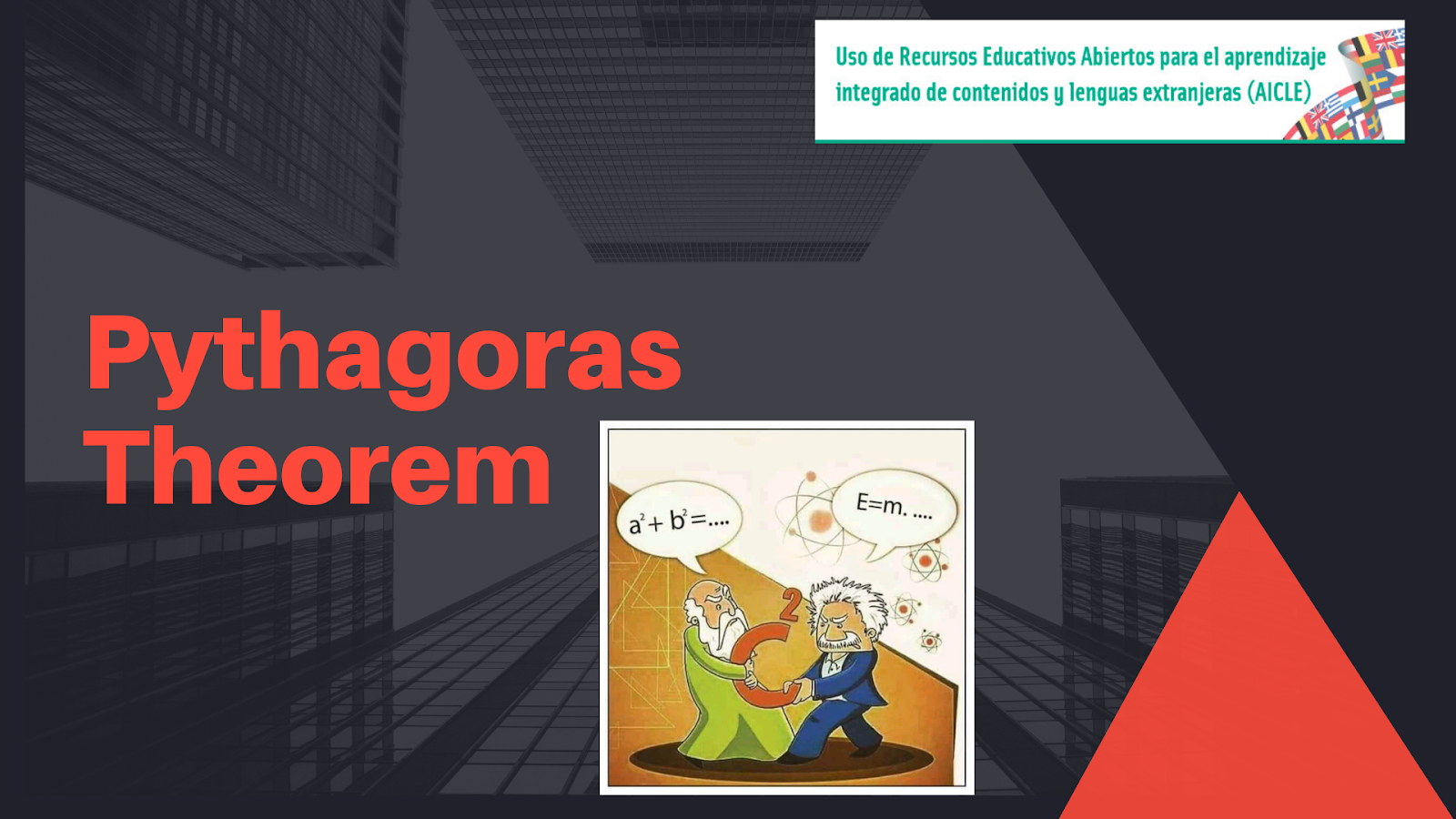
PYTHAGORAS THEOREM

DU Title:  PYTHAGOREAN THEOREM

In this unit we are going to study Pythagoras' theorem and use it to solve problems involving right-angled triangles.


Student should be able to:

  • Determine the relationship between the lengths of the sides of a right-angled triangle.

  • Find the length of the missing side of a right-angled triangle using the Pythagoras' theorem.

  • Solve problems using the Pythagorean theorem

Organization and class distribution.


https://drive.google.com/file/d/1eLLi4jzoEhYMqUi1V6V647pguqYEj1Gl/view)


  • Content Consolidation (3 sessions).

I will dedicate a session in which the students will read articles in which appear applications of the Pythagorean theorem. https://sciencing.com/real-life-uses-pythagorean-theorem-8247514.html

In addition, they will work on the application of the Pythagorean theorem to real life. Each pair of students will have to solve  exercises of worksheet 1

In order for students to continue viewing applications of the Pythagorean theorem, I will use a video of the following:

https://www.youtube.com/watch?v=en6tjt7KL3E

https://www.youtube.com/watch?v=Grzy-ZAotB0

In these sessions the students will also work the following worksheet. This worksheet is also found in escholarium and thatquiz

  • Final session

In this session, students will return to work with the vocabulary of the topic, they will make a form. (This form will be in Escholarium and will be made with Google form)


PYTHAGORAS THEOREM


JOSÉ RAÚL ALEJANDRO BÉJAR


--
José Raúl Alejandro Béjar
Profesor de Matemáticas
IESO COLONOS 
GÉVORA. BADAJOZ

ENGLISH @ SCHOOL

HOLA A TODOS, EL RECURSO AICLE QUE PROPONGO ES EL BLOG ENGLISH @ SCHOOL.

http://bilingualsectionenglishschool.blogspot.com/

EN ESTE BLOG PODEMOS ENCONTRAR DE TODO TIPO DE RECURSOS AICLE SOBRE VARIOS TEMAS, DENTRO DE VARIAS ASIGNATURAS, Y LO MÁS IMPORTANTE, ES QUE TODO SE HA LLEVADO A CABO EN LA REALIDAD EN UN CENTRO DE LA PROVINCIA DE CÁCERES.

ESTA PROFESORA REALIZA CON SUS ALUMNOS DISTINTAS ACTIVIDADES Y EXPERIMENTOS RELACIONADOS CON LA MATERIA IMPARTIDA EN CLASE. DE ESTA FORMA LOS ALUMNOS APRENDEN DE UNA FORMA SIGNIFICATIVA Y LÚDICA.

OS INVITO A ECHARLE UN VISTAZO. UN SALUDO.


POR VIRGINIA MASA REDONDO